
Featured Courses Spring 2027

Click here to take an interacting choose-your-own-adventure quiz to help determine which courses are right for you!
GENED 1042: Anime as Global Popular Culture

Taught by Prof. Tomiko Yoda
What can anime’s development in Japan and its global dissemination teach us about the messy world of contemporary media culture where art and commerce, aesthetic and technology, and producers and consumers are inextricably entangled with each other?
In this course, students will learn to engage Japanese or Japanese-style animation (sometimes known as anime) through two-pronged approaches. First, the students will learn to evaluate the aesthetic and socio-cultural relevance of anime in relation to the criteria and perspectives developed through the study of more established artistic forms such literature, cinema and visual arts. We will cover topics including, anime’s generic conventions, formal aesthetic, and narrative motifs. Secondly, students will learn to address the cultural value of anime in manners that recognize the specificity of its media ecology, encompassing the modes of production, distribution, and consumption. In particular, we will pay close attention to the ways media technology, industrial production of anime, marketing, and fan culture are integral facets of anime eco-system. In this sense, we will study anime as a node in the global network, involving diverse commercial as well as non-commercial medias such as graphic novels, live-action films, video games, character merchandises, and fanzines and other fan practices. The course as a whole suggests that we need to work between these two approaches in order to understand anime as a medium of global popular culture today.
CHNSHIS 146: The Modern History of Rural China
Taught by Prof. Michael Szonyi
Read an article about this course here!
It’s only in the last twenty years that China has become known as a place of cities and factories. Before then, the majority of Chinese people lived not in cities but in villages in the countryside, and made their living from agriculture. This lecture/discussion course, intended mainly for undergraduates, will introduce you to the modern history of rural China. We’ll approach that history chronologically, thematically, and historiographically. No background knowledge of China is required, but the course might interest you even if you have some previous background, because it will show you the People’s Republic of China from a very different angle than what you’ve likely encountered before: that of its villages and the people who live in them. You’ll come to appreciate their perspective better through taking their role in two interactive games. You’ll also learn why the fate of China’s countryside matters to the future not only of China but also the whole world.
EASTD 145: Views from Mainland Southeast Asia: “Indochina” in a Century of Exchanges and Conflict, 1880s–1980s

Taught by Prof. Uyen Nguyen
This seminar introduces students to the modern histories and cultures of Vietnam, Laos, and Cambodia, examining the most consequential episodes in the intertwined and often tumultuous relationships among these three countries from the late nineteenth to the end of the twentieth century. The course pays particular attention to “Indochina” as a colonial and postcolonial framework—one that at times connected, and at other times divided, the region’s peoples and states.
Throughout the seminar, students will engage with scholarly texts and films, as well as literary works, memoirs, and oral histories. The course asks a set of guiding questions: Does geographical proximity foster cultural similarity? Does forced inclusion in a colonial union such as French Indochina unite or divide colonized societies? Does shared political ideology necessarily lead to collaboration and mutual support?
EASTD 111: Buddhism and the Environment

Taught by Prof. Paula Kolata
What can Buddhism teach us about surviving and thriving in the face of ecological crisis? This course examines the challenges and possibilities of life on a changing planet from a Buddhist perspective. Organized thematically around Buddhist concepts such as karma, pollution, suffering, and interdependence, and paired with the material realities of environmental degradation and consumption, the course investigates how Buddhists are responding and contributing to pressing issues such as climate change, extreme weather, biodiversity loss, pollution, waste and wasting, melting glaciers, rising sea levels, and food insecurity.
Rather than offering a comprehensive survey, the course draws on selected historical and ethnographic studies from East and Southeast Asia and Asian diasporas. We will explore how Buddhist practitioners and communities understand and respond to environmental change, as well as how Buddhist institutions and practices may themselves contribute to patterns of consumption and ecological harm. The course critically examines Buddhist environmentalism, including the development of “Buddhist ecology” and efforts to “green” Buddhism, while asking what possibilities and limitations Buddhism offers for imagining life on a damaged planet.
EASTD 197: China's Cultural Revolution

Taught by Prof. Daniel Koss
This course introduces a cataclysmic movement that brought the People’s Republic of China to the brink of anarchy: The Great Proletarian Cultural Revolution (1966-1976). The first part looks at historical precursors, including rebellion in the imperial era, political movements in the Republican Era, Communist campaigns and purges, as well as the Great Leap Forward famine that cost tens of millions of lives. Paying equal attention to elite politics at Mao Zedong’s “court” and the lived experiences of ordinary citizens, the second part focuses on the evolution of the turmoil, once Mao had called for “bombarding the headquarters” of his own party state, discussing the “Gang of Four,” the “attempted coup” by Lin Biao, the Red Guards and the worker rebels in Shanghai, local power seizures and factional warfare, military crackdowns, and the return to order. The third part begins with the reception of the movement abroad, and focuses on its afterlives, including the quasi- pluralist lessons drawn in the immediate aftermath, the role of Cultural Revolution legacies in decisions such as the violent crackdown on the Tiananmen protesters in 1989, and memory politics under Xi Jinping. No language requirement.
KORLIT 110: Classical Korean Literature

Taught by Prof. Si Nae Park
Introduction to the literature and literary culture of the Chosŏn period (1392-1910) through deep, slow, and close reading, creative writing, and an exploration of authentic materials held by the Harvard-Yenching Library, Harvard Map Collections, and Harvard Art Museums. Students will gain a solid understanding of key literary forms, motifs, techniques, works, and modes of textual circulation while critically engaging with questions of history of reading, canon formation, cultural heritage, and world literature. All readings are in English, and no knowledge of Korean culture and history is expected.
EASTD 194: Historical Legacies in East Asian Politics

EASTD 194: Historical Legacies in East Asian Politics
Taught by Prof. Daniel Koss
How does the historical past shape politics in the present? East Asia and its recent political developments provide a most striking universe of cases, where legacies of the past influence both domestic politics and international relations. Located at the intersection of history and political science, this course is grounded in theories of institutional development, introducing concepts such as path dependence, critical junctures, and unintended consequences. Beginning with China, the course discusses explanations of development successes grounded in grand narratives going far back in time; the impact of cultural norms, imperial techniques of statecraft, revolutionary practices; the uses and abuses of history in the service of the party state; and the long-term impact of Christian missionaries, Japanese colonizers, and a decade of warfare. Through the case of Japanese domestic politics, we explore how tradition is transmitted through habits and memories of individuals; through institutions such as the perennial ruling party; and through a broadly defined civil society. As examples of critical junctures, we will discuss North Korea’s early postwar history and South Korea’s democratization process, discovering their enduring influences on both political systems. Turning to international relations, this course asks whether foreign and security policy is the result of a deeply rooted strategic culture, how diplomats maneuver the divisions over historical guilt of World War II, and what narratives such as the “century of humiliation” reveal about actors’ strategic thinking. Throughout the course, we will pay attention to regional linkages.
CHNSHIS 146: The Modern History of Rural China

Taught by Prof. Michael Szonyi
Read an article about this course here!
It’s only in the last twenty years that China has become known as a place of cities and factories. Before then, the majority of Chinese people lived not in cities but in villages in the countryside, and made their living from agriculture. This lecture/discussion course, intended mainly for undergraduates, will introduce you to the modern history of rural China. We’ll approach that history chronologically, thematically, and historiographically. No background knowledge of China is required, but the course might interest you even if you have some previous background, because it will show you the People’s Republic of China from a very different angle than what you’ve likely encountered before: that of its villages and the people who live in them. You’ll come to appreciate their perspective better through taking their role in two interactive games. You’ll also learn why the fate of China’s countryside matters to the future not only of China but also the whole world.
Japan 106A: Classical Japanese
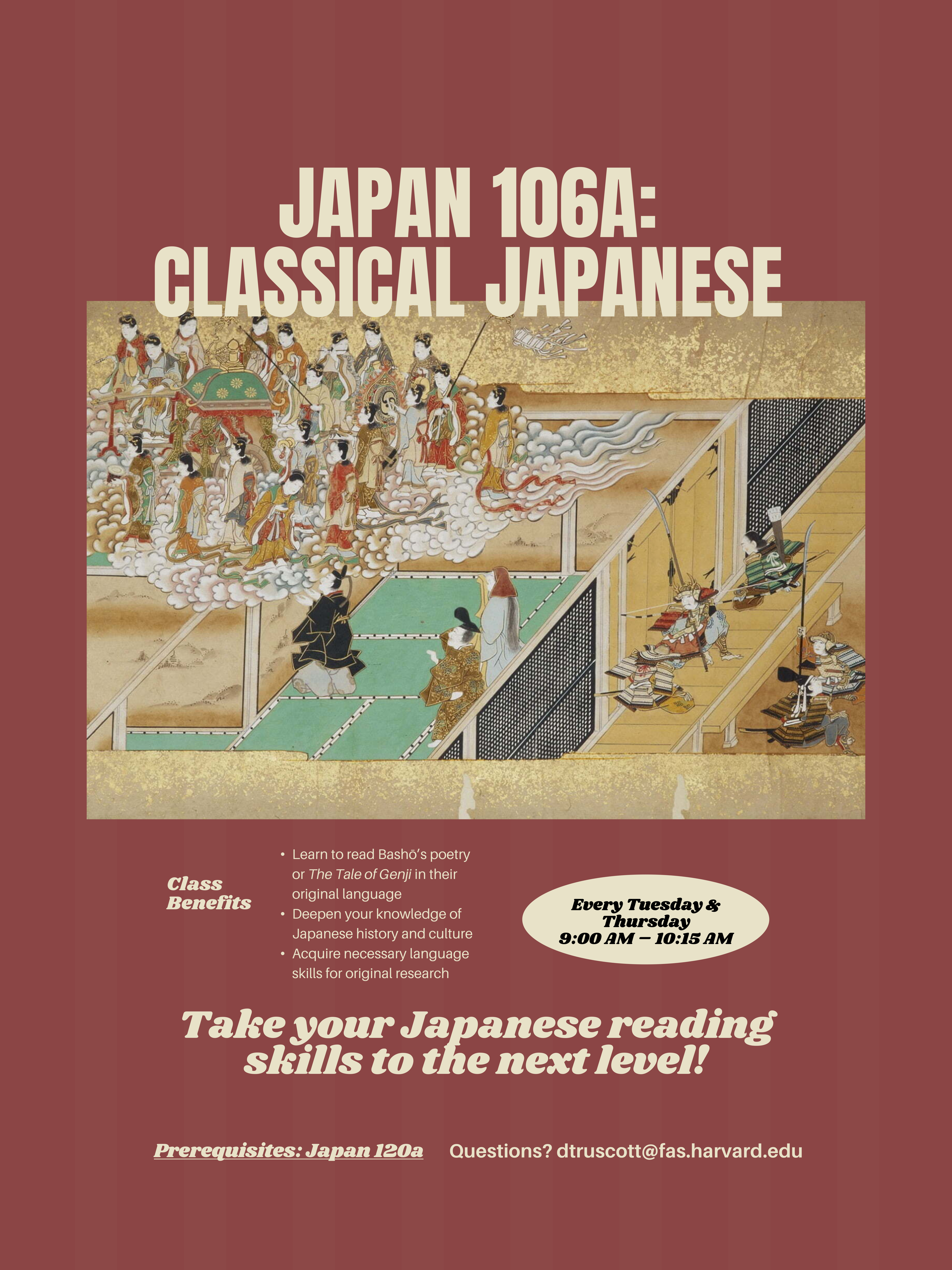
JAPAN 106A: Classical Japanese
Taught by Danica Truscott
In this course, we will learn and practice reading the fundamental grammatical patterns of classical, or literary, Japanese (bungo). From Murasaki Shikibu’s The Tale of Genji to Bashō’s famous haiku, this linguistic form appears in a wide variety of Japanese literature. In fact, traces of classical Japanese can still be found in modern Japanese and are often employed in news articles and song lyrics. As we read poetry, short stories, diaries, and more, students will not only gain the ability to read premodern vernacular texts with the aid of a dictionary, but will also develop a deeper appreciation for Japanese language and culture across the ages.
EASTD 271: Language, Script, & Power in East Asia

Taught by Prof. Si Nae Park
In this graduate seminar, students will explore the ways in which debates and negotiations about languages, writing systems, and linguistic and script diversity in East Asia matter in the formation and dispersal of imagined communities, establishment of and challenge to political power, social reproduction, and more. The course’s wide-ranging readings are culled from diverse fields and disciplines including the history of writing, reading, and the book in East Asia (China, Japan, Korea, and Vietnam); linguistic anthropology; sociolinguistics; and studies of modernity/modernism and of colonialism and post colonialism. Examining the relationships between language, culture, and society in societies of East Asia in the past and the present, students will develop comparative (cross-regional, cross-temporal, and cross linguistic/script) and interdisciplinary approaches to the study of East Asia. This seminar is not a language or linguistics course. All readings are in English.
Uyghur and Chaghatay Courses

Japanese Courses
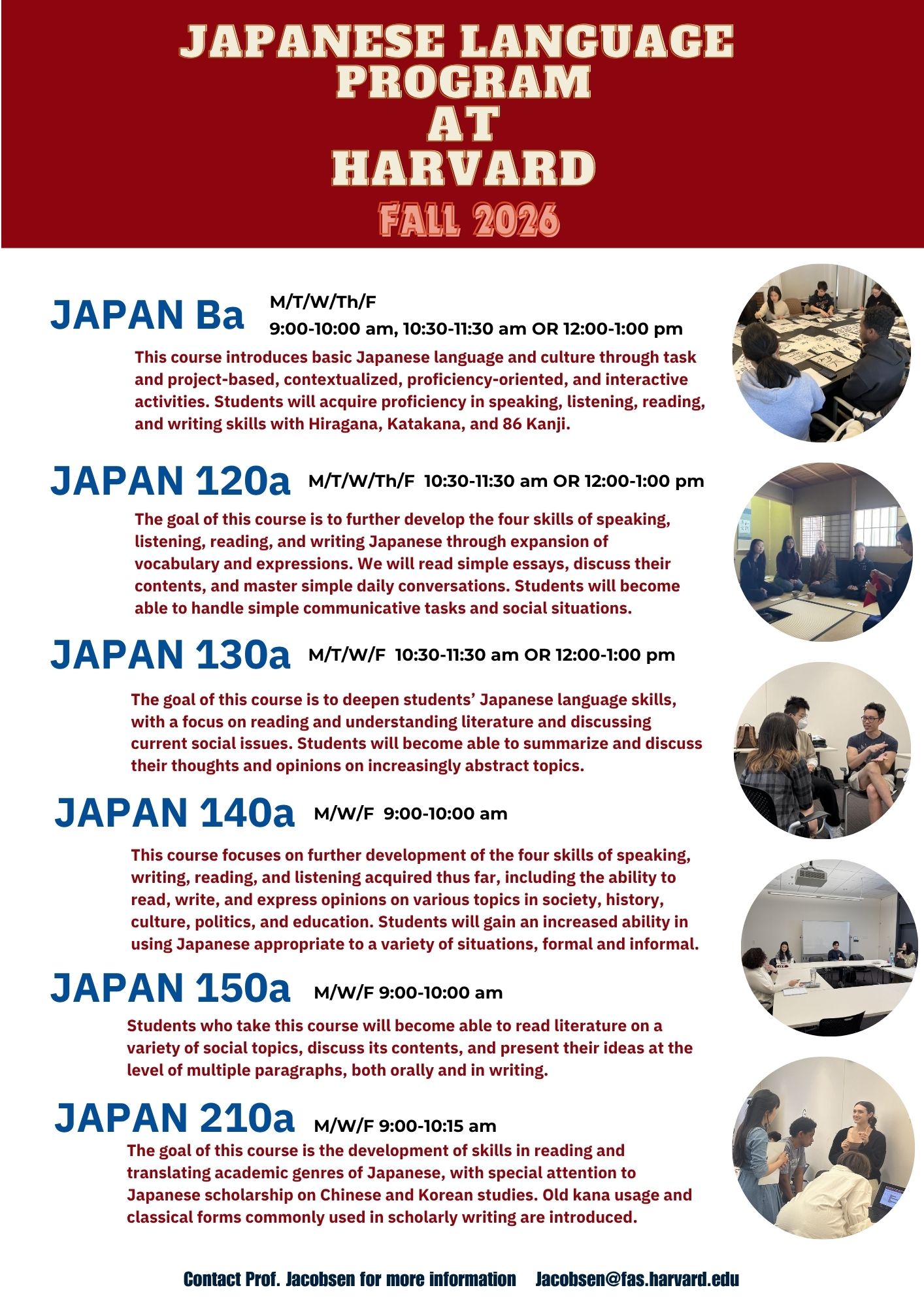
Vietnamese Language Courses
