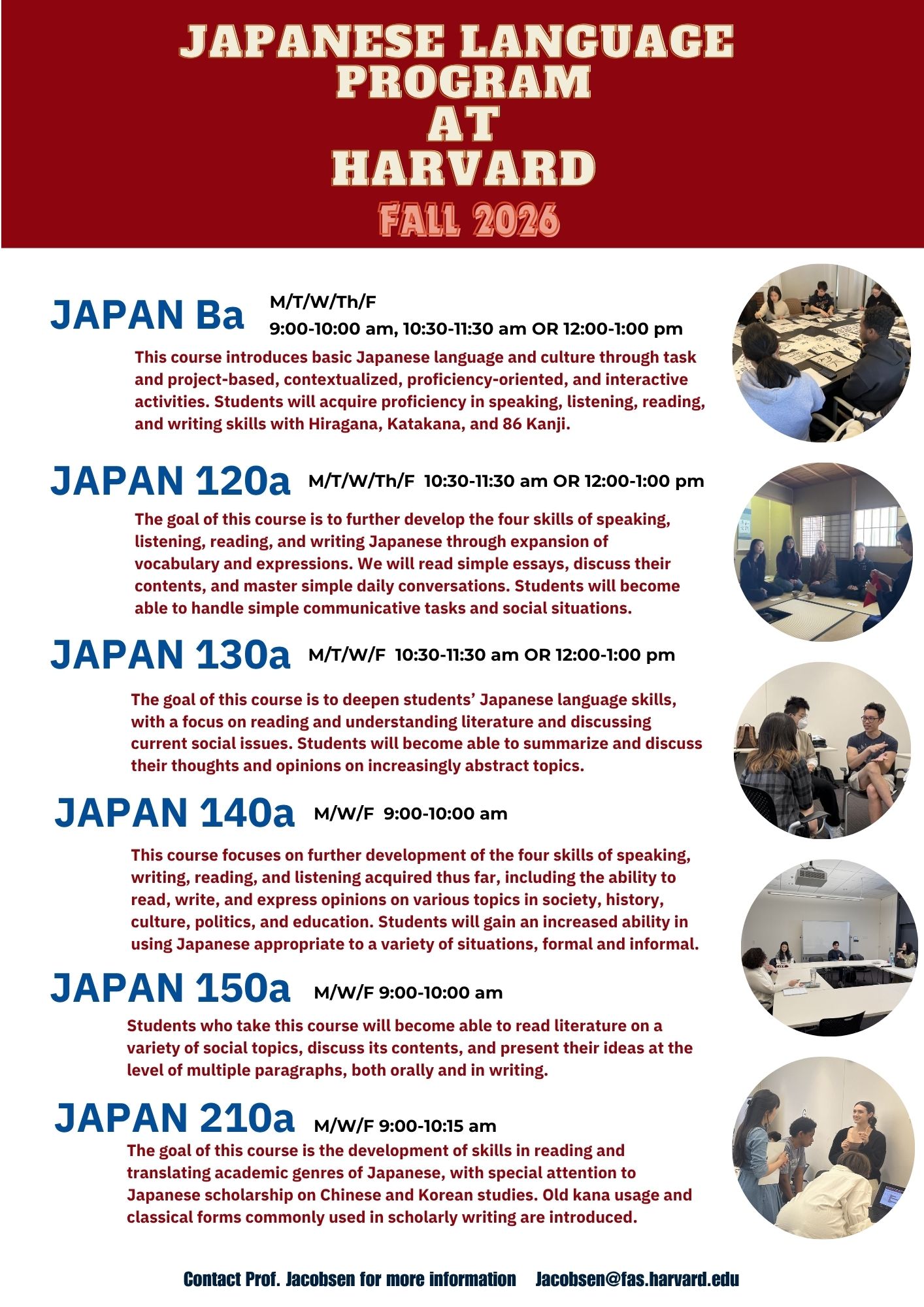
Featured Courses Fall 2026
To take an interactive quiz that will suggest area courses to match your interests, click here!

EASTD 151: Documenting China on Film
Taught by Prof. Jie Li
What defines a film as “documentary”? How do documentary films inform, persuade, provoke, or move us? Of whom, by whom, and for whom are documentaries made? Can documentary also be “propaganda” or “art”? What rhetorical devices and aesthetic strategies do documentaries use to construct visions of reality and proclaim them as authentic, credible and authoritative? What might documentary films—as opposed to written text—teach us about modern Chinese history and contemporary society? Above all, how would you go about making a documentary film, in China or elsewhere?
In this course, we will examine documentary films made in or about China from the early 20th century to the present day, through the lenses of both Chinese and foreign filmmakers. We will interrogate the visual “evidence” that camera images can offer, look into their production and reception histories, as well as discuss the ethics, aesthetics, and politics of documentation, representation, and exhibition. Weekly topics are roughly grouped into three parts: (1) “Witnessing History” (2) “Social Reportage” and (3) “Art, Experimentation, and Fiction.” The first part will cover the cinematic history and memory of World War II, the Cultural Revolution, and the 1989 Tiananmen protests. The second part will explore documentary engagements with contemporary issues ranging from social inequality, migrant labor, forced demolitions, and environmental degradation. The third part will consider the art of observation, the potentials of experimentation, and the porous boundaries between documentary and fiction. Viewings of documentary films will be complemented by theoretical and contextual readings, as well as short assignments to engage critically and creatively with the films we watch. The final project for the course will be to make a documentary film in a small group.
CHNSLIT 134: Strange Tales: The Supernatural in Chinese Literature

Taught by Thomas Kelly
This course introduces students to traditional Chinese literature by focusing on “tales of the strange.” We will examine how ghosts, demons, fox spirits, and other liminal creatures haunt the literary imagination, stretching the possibilities of storytelling. Students will gain familiarity with masterpieces of Chinese literature and their intriguing afterlives in performance, film, and popular culture. Our discussions will consider how literary accounts of ghosts and the supernatural grapple with issues of gender and sexuality, the cultural meanings of death, the boundaries of human community, and the experience of historical trauma. We will focus on developing skills in close reading, while critically engaging theories of the “strange.” No background in Chinese is required.
KORLIT 141: K is for Korea: Reading a Culture Through Pages, Soundscapes & Images

Taught by Si Nae Park
BTS, Parasite, K-pop, and Han Kang are widely recognizable icons of Korea today. With the global spread of “K-culture” and the increasing use of the prefix “K-” to signal cultural value and visibility, this course asks: what does it mean to read culture as a text? What kinds of cultural forms are produced, curated, consumed, and performed as “Korean,” and why? How can historical perspectives complicate and deepen our understanding of contemporary Korea? In this course, students will examine works of Korean literature, music, visual arts, and media—from both contemporary contexts and earlier historical periods—to explore the origins, transformations, and contestations surrounding the question “What is Korea/Korean?” Rather than seeking a single, unifying definition or a catch-all formula, the course approaches Korea/Korean as a set of collages and composites shaped by conflicting, complementary, and often invented ideas and materials. A central goal of the course is to encourage deeper engagement with familiar cultural icons by slowing down interpretation and situating them within longer historical timelines and broader spatial frameworks. Through these materials and approaches, students will hone skills in close reading, critical viewing, informed commentary, and content creation. Key themes include cultural boundaries and hybridity, approaches to cultural history, and cultural curation as a social, historical, geographical, aesthetic, and imaginative practice.
This course fulfills the Historical Survey Requirement for EAS Concentrators.
JAPNHIST 160: Japanese Economic History

Taught by Jesús Solís
The rapid rise of the Japanese economy throughout its modern history has fascinated historians and economists. Japan was the first non-Western nation to industrialize. This unique development had its roots in the Meiji government’s policy of creating a “strong army and rich country” as a way to survive the world of competitive empires in the nineteenth century. The country achieved great power status during the early twentieth century, but Japan’s economy was devastated after its disastrous defeat during World War II. The defeated nation once again stunned the world as it rose from the ashes of defeat to become one of the greatest economic powers in the postwar period. This course will explore these major economic developments in Japan’s modern history. Why was Japan the only country outside the West to industrialize? What caused the country to achieve such rapid economic growth after WWII? What are some of the major economic challenges facing Japan today? These are some of the questions that we will answer throughout this course.
EASTD 144 - Vietnam in the Twentieth Century: History, Culture, and Identity

Vietnam in the Twentieth Century: History, Culture, and Identity
Taught by Uyen Nguyen
This lecture course introduces students to the modern history and culture of Vietnam by examining major visions of “Vietnam” as a state and as a people that emerged over the twentieth century. Drawing on historical narratives and cultural productions, the course explores themes such as ideas about the origins of Vietnamese society and culture, Vietnam’s relations with its neighbors, colonialism, anticolonialism and nationalism, war, and postwar challenges. Rather than treating “Vietnam” as a continuous and unified entity stretching back to the prehistoric Dong Son culture, the course highlights competing understandings of “Vietnam” and of what it has meant to be “Vietnamese,” as they took shape at key moments in the country’s modern history.
This course counts towards the historical survey requirement for EAS concentrators/secondary fielders, or may count as a junior tutorial with extended final paper required (advance instructor and DUS approval needed).
EASTD 196: Political Geography of China

Political Geography of China
Taught by Daniel Koss
Putting Chinese politics on the map, this course asks how the government deals with the enormous challenges of ruling over a vast terrain with a diverse population, encompassing super-rich urban metropolises as well as poor rural peripheries. We begin with statecraft traditions from the late imperial era; and end with China's place on the future global maps of the 21st century. Topics include: macro-regions; priority zones of governance; Special Economic Zones; the Chinese equivalent of “blue states and red states;” rising inequality; ethnic minorities and borderlands; economic development models; urbanization and city planning; collective action in digital space; domestic and international migration; environmental politics; and the geo-politics of the “One Belt One Road” initiative. We will set aside class time for a hands-on introduction to producing and interpreting maps of China.
This course counts as a junior tutorial, and fulfills the 100-level EALC course requirement for EAS secondary fielders.
JAPNLIT 170

Traditional Japanese Literature: From Mythology to (Early) Modernity
Poetry written by gods, incestuous aristocratic romances, exorcist theater, samurai fantasy novels, fart literature: traditional Japanese literature has something for everyone, and invites us to rethink our assumptions about what literature is and how creativity works. From the most ancient myths up to the 19th century arrival of Western style modernity, we will explore together the relationships between high art and pulp fiction, the stage and the page, words and illustrations, manuscript and print, language and the sacred. We will probe the literary imagination of beauty, nature, desire, and heroism, and ask—through creative experiments and reflections that connect what we are reading to our own lives—what Japanese literature can tell us about what it is to be human.
All are welcome; no prior knowledge of Japanese literature or history is required.
Course Notes:
This course fulfills the East Asian Studies concentration "Historical Survey" requirement.
EASTD 112

Buddhism and the Senses [aka "Buddhist Stuff"]
Taught by Paula Kolata
How does Buddhism smell, taste, sound, look, and feel? This course explores how bodies experience religious worlds. We will investigate how Buddhists encounter divine presence, religious rules, sacred spaces, and powerful imaginaries through the senses. Moving beyond texts and doctrines, we will step into the sensory and embodied practices that make Buddhist worlds tangible: from spirit possession and prayer rituals to carving statues, cooking and tasting feasts, and rolling and smelling incense. You will not only study but also experiment with methods that attune us to the sensory life of religion. Along the way, we will probe what “religious affects” mean and how embodied practices generate lived realities. At the same time, you’ll gain a theoretical and methodological grounding in the study of material religion, learning how to analyze the entanglements of objects, bodies, and belief. By the end of the course, you will have both experienced and critically reflected on how religious worlds come alive through the senses.
Japan 106A: Classical Japanese
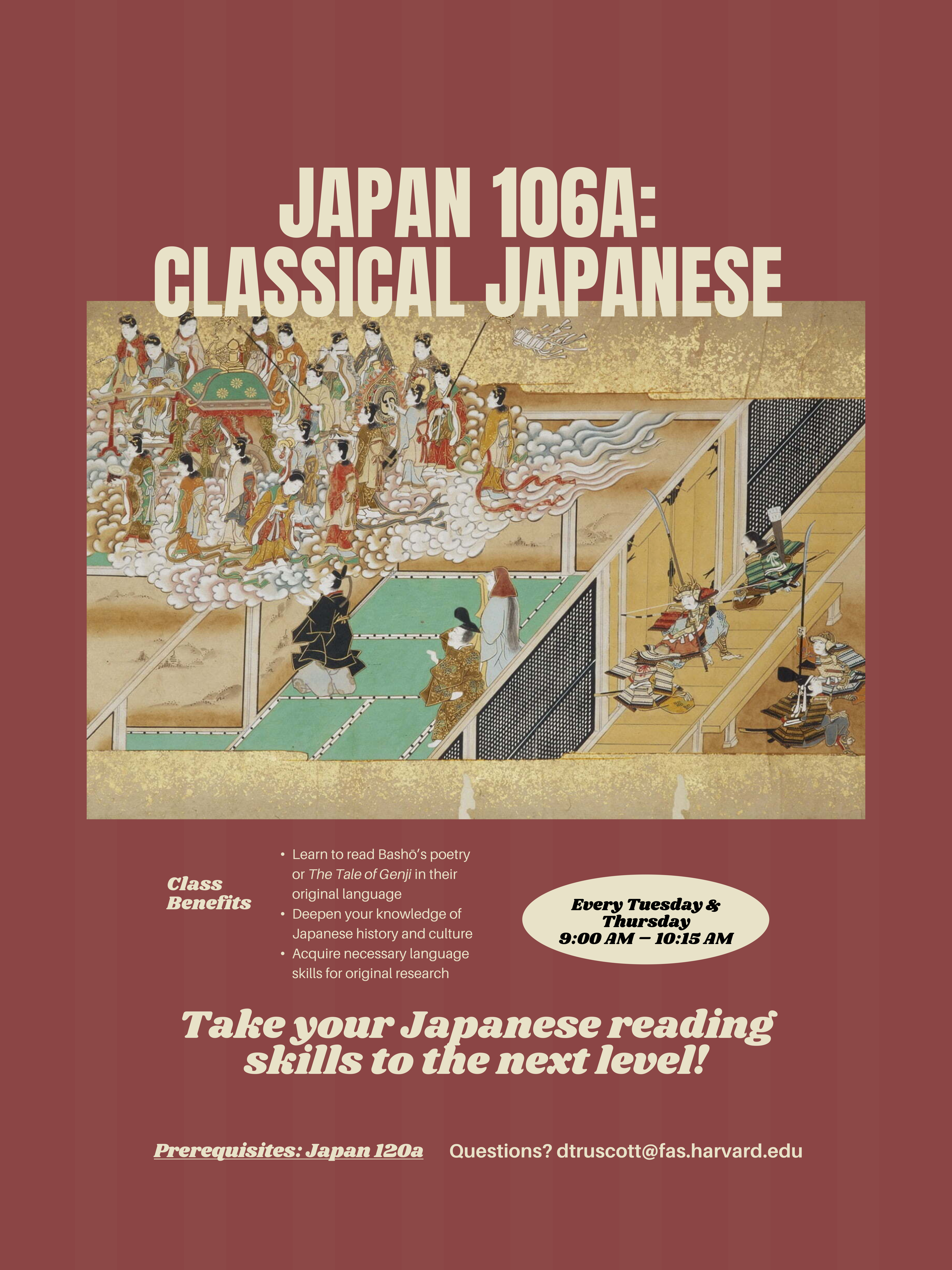
JAPAN 106A: Classical Japanese
Taught by Danica Truscott
In this course, we will learn and practice reading the fundamental grammatical patterns of classical, or literary, Japanese (bungo). From Murasaki Shikibu’s The Tale of Genji to Bashō’s famous haiku, this linguistic form appears in a wide variety of Japanese literature. In fact, traces of classical Japanese can still be found in modern Japanese and are often employed in news articles and song lyrics. As we read poetry, short stories, diaries, and more, students will not only gain the ability to read premodern vernacular texts with the aid of a dictionary, but will also develop a deeper appreciation for Japanese language and culture across the ages.
JAPAN 106B: Introduction to Kambun

JAPAN 106B: Introduction to Kambun
Taught by Danica Truscott
In this course, students will learn how to read a variety of Japanese texts written entirely in Chinese characters, or kanbun. Specifically, we will practice the art of rendering both classical and quasi-classical Chinese script into Japanese syntax, a reading method known as kundoku or yomikudashi. After learning the basics via textbook, we will read texts from several different genres such as mythologies, histories, and official documents. By taking this course, students will begin developing the necessary skills for reading primary sources produced by Japanese officials and literati with the aid of a dictionary, laying the groundwork for further training in students’ specific fields of research.
Uyghur and Chaghatay Courses

Japanese Courses